In Search of Robinson Crusoe by Tim Severin
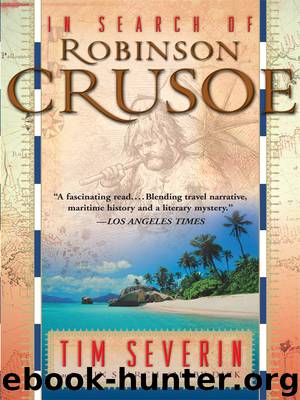
Author:Tim Severin [TIM SEVERIN]
Language: eng
Format: epub
Publisher: Basic Books
Published: 2012-01-01T16:00:00+00:00
Kendra employed an eloquent range of gestures, facial expressions, and other stratagems during her Miskitu conversations. To glean information, she might raise a quizzical eyebrow, turn the corners of her mouth up and down like a cartoon drawing to express her feelings, or put on the air of an innocent, a comedienne, or a coconspirator. She knew just when to pause, offering the interviewee a gap to fill with a reply. If a statement seemed exaggerated, Kendra tilted back her head, half-closed her eyes, and looked doubtful, and gave her informant a chance to correct what had just been said. And when an informant was in full flow, Kendra would coo encouragement with an admiring and carefully modulated “aoooaw” “aoooaw,” the sound a Miskito makes when listening with approval. After Kendra had talked with the Miskito men, she would drift away. She was en route to the cookhouse. From the women she picked up the gossip.
We had puzzles to solve. Why were some Miskito houses so much more substantial than others, obviously having cost a lot of money? How could Siriaku afford a smart fiber-glass skiff and a brand new motor? Who paid for the expensive gold necklaces worn by many of the young Miskito girls or the dentistry that gave their elders a gleam of gold teeth? How could anyone afford such high-priced items in an economy whose cash came from the sale of lobster tails, and where most people lived on a diet of rice, cassava, yucca, and turtle meat? Very soon Kendra had found an entirely new meaning for what it now means to be a Miskito “striker”: the wealthy people were those who had made “a lucky strike.”
A lucky strike was the accidental discovery of a bale of narcotics. These “strikes” were astonishingly frequent. They might happen at least once a week in the right season of June and July and then again in November and December. A single really big strike might net more than forty pounds of drugs. The strikes occurred at sea or on land. The crew of a turtle boat pulled up a bale of drugs caught in their net; a ferryman spotted a bundle of drugs bobbing in the waves; a beachcomber came across a carton washed up on the strand. The packaging was usually intact. Black rubber sheeting kept out the seawater, and inside the bales, the narcotics—marijuana or cocaine—was divided into smaller plasticwrapped packets, usually of one kilo in weight. These packets often bore trade symbols. Cocaine in packs stenciled with the icon of a bicycle, for example, was of better quality than those marked with the outline of a football. Where this extraordinary manna came from was unclear. It had begun in the late 1980s. Some said that the narco-traffickers stashed the drugs on the cays to be picked up later; others that highspeed smuggling boats dumped the bundles overboard when the authorities were in hot pursuit. If a boat was caught and had no drugs aboard, there was no evidence for the prosecution.
Download
This site does not store any files on its server. We only index and link to content provided by other sites. Please contact the content providers to delete copyright contents if any and email us, we'll remove relevant links or contents immediately.
How to Read Water: Clues and Patterns from Puddles to the Sea (Natural Navigation) by Tristan Gooley(3507)
Full Circle by Michael Palin(3475)
Into Thin Air by Jon Krakauer(3452)
How to Read Nature by Tristan Gooley(3387)
In Patagonia by Bruce Chatwin(2973)
A Thousand Splendid Suns by Khaled Hosseini(2747)
The Lost Art of Reading Nature's Signs by Tristan Gooley(2717)
The Queen of Nothing by Holly Black(2656)
Don't Sleep, There Are Snakes by Daniel L. Everett(2626)
Venice by Jan Morris(2611)
The Songlines by Bruce Chatwin(2597)
City of Djinns: a year in Delhi by William Dalrymple(2580)
L'Appart by David Lebovitz(2541)
The Big Twitch by Sean Dooley(2471)
Tokyo Geek's Guide: Manga, Anime, Gaming, Cosplay, Toys, Idols & More - The Ultimate Guide to Japan's Otaku Culture by Simone Gianni(2400)
Come, Tell Me How You Live by Mallowan Agatha Christie(2282)
INTO THE WILD by Jon Krakauer(2230)
A TIME OF GIFTS by Patrick Leigh Fermor(2226)
Iranian Rappers And Persian Porn by Maslin Jamie(2225)
